We built a tender radar because we kept finding out late
Public tenders in Honduras are published across a dozen sites on no particular schedule. We stopped checking them by hand and wrote something that checks for us — then found out the interesting part wasn't the scanning.
By VRTKL MEDIA
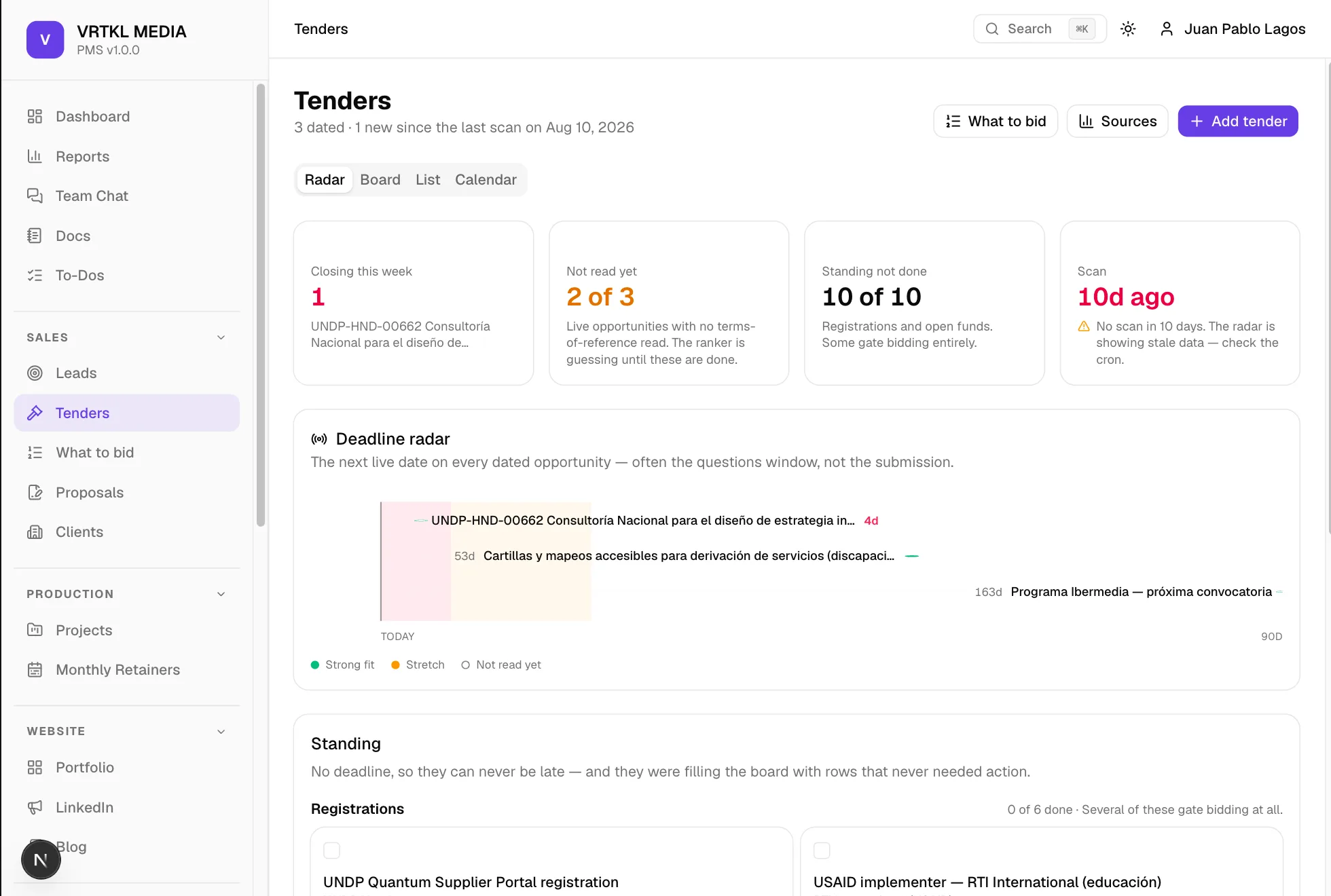
Public contracts here are not published in one place. They arrive on ministry sites, municipal portals, newspaper notices and a handful of job boards, on no shared schedule and in no shared format. The practical effect is that you find out about a tender you could have won three days after the questions deadline closed.
For a while our answer was discipline: a recurring reminder, a list of sites, someone opening tabs on Monday morning. That works exactly as long as nobody is busy, which is to say it does not work.
What we actually built
A scanner that runs twice a week, pulls what's new from the sources we've registered, and drops each opportunity into a board with a deadline on it. Nothing about that is technically remarkable. The parts that took thought were the ones that decide whether anyone trusts it:
Every tender records where it came from, so we can tell which sources produce work we actually pursue rather than which produce the most noise.
The scoreboard counts pursued tenders, not scanned ones. Volume is easy to generate and tells you nothing.
A gap check reads the terms of reference against what we can genuinely document about the company — years operating, past contracts, staffing — and flags where we don't qualify before anyone writes a proposal.
The part we didn't expect
The single best source in the first weeks was a job board. Not a procurement portal — a site we hadn't registered at all, and wouldn't have thought to. We only learned that because attribution was built in from the start.
The value wasn't the scanning. It was finally being able to answer which of these sites is worth our attention.
That's the shape of most automation worth doing. The obvious win is the hours you stop spending. The real win is that the work leaves a trace, and a trace is something you can reason about.
Where it stands
The radar is live and feeding our own pipeline. Ranking and the submission workflow are still ahead of us — right now a human decides what's worth bidding, which is the correct place for a human to be. We'd rather ship the part that's obviously right than guess at the part that isn't.
- automation
- operations
- tenders